Wednesday, September 16, 2009

Tips for a New Roadie Part 3 - Accessorize

Now you've picked out the frame and groupset that's perfect for you and your budget. However, you're not done yet. Don't forget to budget in some of the items that aren't included in the bike, but are essential for happy cycling.

First and foremost on your list should be a helmet. I am a helmet advocate. Do helmets conclusively protect cyclists? Some studies say yes, others no. However, to me any piece of padding you can include between yourself and the hard ground is well worth it. The good thing about bicycle helmets is they are all certified by the same CPSC standard in the US. So in theory a $20 helmet should protect you as well as $200 helmet. If you're looking for a way to save a little cash, this is an item where a less expensive model can be used. What separates more expensive helmets from cheaper ones are lighter weights and better ventilation. It's a good idea to take these into account, as comfort can be very important during long rides in hot climates. The Specialized Echelon is a great helmet for entry level riders. It has the same shape and ventilation system as the $200 S-Works, is lightweight, has a great adjustment system, and costs just $60.
The Specialized Echelon is a great choice for a first helmet

The next item on your purchase list should be pedals and shoes. Your new bike will likely come with plastic pedals equipped with toe clips. These are fine on short rides. However on longer rides they can lead to numb toes and don't promote an efficient pedal stroke. "Clipless pedals," so named because they lack toe clips, are the ones you actually clip into. Since your feet are connected to the pedal you can not only push down, but also pull up on creating a more efficient pedal stroke as well as recruiting the hamstrings to share some of the burden. Stiff soled cycling shoes help prevent numb toes and ensure that all pushing or pulling energy your feet exert help to move the crank. Pedals and shoes are the one accessory that will actually make you faster. Shimano's 105 pedal is a great entry level road pedal. They are easy to clip and out of and the wide base gives a nice solid platform to prevent hot spots. Although the cleat might need to be replaced every season, it doesn't require the maintenance Speedplay cleats do. A careful shopper can find them for $60-80 at various online outlets. Shoes are an item of great personal preference, so I am hesitant to recommend a brand or model. Any stiff soled shoe will do as long as it fits and is comfortable. This is one item you should try before you buy. Most cycling shoes use Euro sizing, so the size of your tennis shoes will probably be different from your cycling shoes.

Shimano's 105 Pedals are a great entry level option

While a Camelbak might be perfectly appropriate for mountain biking, it's faux pas on a road bike. Water bottles and cages are a must. Rides can last for hours so it's important to keep your body well hydrated along the way. Fortunately this doesn't have to be anything fancy. Unless you want to shave every ounce off your bike, skip the fancy carbon cages and stick with aluminum ones. Throw in a couple of cheap water bottles and your setup is complete. A savvy negotiator should be able to negotiate these in as freebies when they purchase their bikes. If you can't, this shouldn't cost more than $15.

Along the same lines, while cycling you're bound to have a flat someday and you should be prepared to fix them yourself. Any cyclist worth his salt has a seat bag filled with a spare tube, patch kit, and some sort of inflation system (either CO2, a hand pump, or both). A portable multi-tool is also a good idea in case a bolt may need tightening along the way.

A proper pair of cycling shorts is another item I wouldn't leave the store without. Cycling shorts like helmets are another item which can get very expensive. However, this is an area where I wouldn't substitute for quality. A good pair of cycling shorts has a comfortable chamois which takes pressure off your sit bones. A quality lycra that compresses your leg muscles can help stave off fatigue. Bib shorts offer the added benefit of not having a waist band that digs into your side and the shoulder straps hold the chamois in place better than standard shorts.

All told, these items can add up. However, now is the season to buy since deep discounts can be had as 2009 models are closed out. Also, there are always deals on websites like Bonktown and Chain Love which offer 50-80% off items. Other companies like Competitive Cyclist offer deals only announced on their twitter feeds. The accessories you choose can contribute to a pleasant cycling experience just as much as a bike, so careful selection is a worthwhile investment. If you can't stand the numbness in your toes or the pain in your butt, the best bike in the world won't solve those problems.

Sunday, September 13, 2009

Oakley Jawbone Review

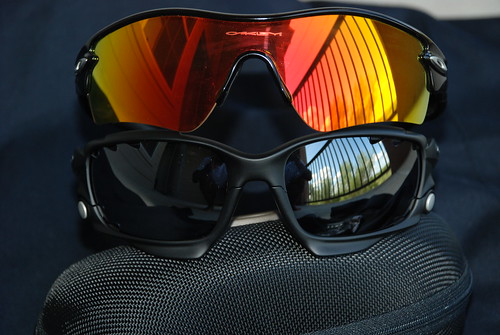
The first time I saw the Oakley Jawbones debut at this year's Tour de France I was very skeptical. They seemed to be a big departure for Oakley's sports line which features models with no bottom rim to obstruct downward views. They also have lenses "suspended" in the rim, reducing stress on the lenses and improving optical quality. Again this seems redundant since all Oakley lenses incorporate their HDO technology. My current riding glasses are Oakley Radars. My sunglasses for everything else are Oakley Flak Jackets. I love them both and have very few complaints. I wear the Flak Jackets while playing golf, and have never experienced any distortion. However, the more I saw of the Jawbones, the more intrigued I was. Once I tried them on, I was sold.

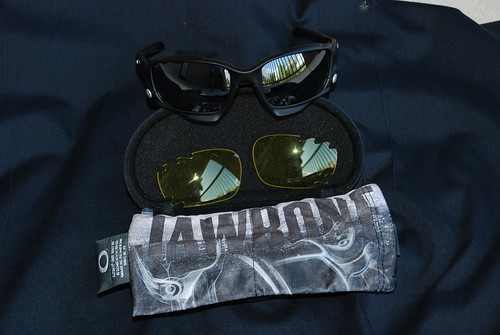
The Jawbone package complete with extra lenses, soft case, and lens cloth.

The most obvious piece of technology in the Jawbones is Switchlock. The bottom rim of the frame is hinged and designed to swing down once the locking nose piece is flipped up. This makes switching lenses very easy and also allows the lens to be suspended inside the frame which gives the lenses optimal clarity since the frame exerts almost no pressure. The lenses are also coated in Oakley's hydrophobic coating to help repel dust and oils.

The Jawbone and Radar have almost identical lens coverage

Initially I was worried that the Jawbones might be too large for my smaller face. However, I was very pleased to find they fit great. That's not to say the Jawbone is a conservatively shaped pair of glasses, and the colors Oakley has chosen reflect that. Thankfully, matte black is a welcome option for guys like me who prefer to blend into the crowd. This model combines the most subtle frame color with my favorite lens tint. If you want, there are neon yellow, bright orange, white and Livestrong models as well.

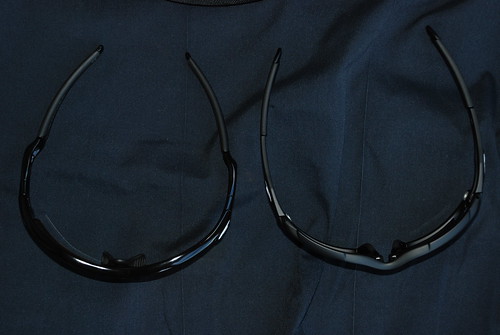
Performance wise, Oakley may have created the perfect set of cycling glasses. I was a very big fan of the Radars. I loved the full frame coverage the lenses provided. However, the ear stems were a touch too long and frequently hit the back of my helmet causing the glasses to need mid-ride adjustments. The Flak Jackets were very light and comfortable but didn't have the lens coverage I desired while riding. With the Jawbones, Oakley created the perfect compromise between the two. The Jawbones are as light and comfortable as the Flak Jackets, but the larger lenses provide much more coverage. Oakley also shortened the ear stems compared to the Radars helping the Jawbones fit much better under helmets and hats.

Jawbone (right) has shorter and more comfortable ear stems than the Radar (left).

The frame feels very solid. The ear stems fold out and "click" into place with a very solid feel. There are no creaking noises such as the ones which emanate every time you move the Radar's ear stems. The vents on the lens prevent fogging even in very hot temperatures. The lens coverage is excellent and the shape of the lens is the first I've found that doesn't rub against my eyelashes.

Switching lenses is also extremely easy. I'm not 100% sold on the Jawbones having any better optical quality than other glasses. However, the Jawbone system makes lens changes very easy. Changing lenses with the Flak Jackets and Radars involves some bending, pushing, and pressure. It can be difficult and done incorrectly can lead to breakage. The Jawbones make things much easier. Simply flip up the nosepiece, swing the frame down, and slide the lens out. No hassle or stress at all.

Switchlock in action. Image from Oakley's Website.

There is not much I have to criticize with these glasses. One bone I have to pick are the spare lenses. Oakley was kind enough to include an extra pair of lenses for "low light" conditions. However, the second lenses are either yellow or persimmon tinted. Not typically the sort of lens I see most cyclists donning, even in very low light. For a $200 pair of sunglasses, the extra lenses are a nice touch, but how more useful tint like the G30? Also, after over two years of wearing glasses without a bottom rim, it took some time to get used to looking down and seeing a black line with the Jawbones. However, after a few minutes, it's a non-issue.

When it's all said and done, the Jawbone is an extremely comfortable and well designed pair of glasses. Their shape may not be the perfect fit for everyone, but current Radar and Flak Jacket owners who find themselves wanting a good compromise between the two should give the Jawbones some serious thought.

Wednesday, September 9, 2009

Hitting the Trails

Most of my road biking life has been spent on the smooth tarmac of two lane roads. I've grown very accustomed to riding in close proximity with cars and fairly skilled at finding long stretches of road with wide shoulders. My limited experience with bike paths and trails has come on charity rides where the routes are closed. Over Labor Day Weekend I spent some time in Dallas and had the opportunity to ride a multi-use path known as "White Rock Ramble." As a rider who spends most of his time on the roads, switching over to the MUP was a very interesting experience as there are some marked differences between the two.

The trademark sign of the multi use path

One of the most fun aspects of riding the MUP were the turns you simply can't find on any road. I found myself smiling from ear to ear as I attacked hairpin bends that switch from right to left in just a few feet. Those are the sort of turns you can't experience on any roadway. Interestingly enough I found that I was more comfortable making sharp turns to the right than the left. After some practice I found myself getting much more confident moving to my left.

While it's a lot of fun diving through turns at speed, I found it very difficult to get up to speed because of all the traffic. Dodging walkers, joggers, pet enthusiasts can be quite a challenge on a road that's barely wider than two sets of handlebars. Add in cyclists traveling from the opposite direction and it goes from a challenging to dangerous. I found that many inexperienced cyclists sometimes brake too late and too hard, nearly locking up their brakes and not providing cyclists behind them with hand signals for slowing or stopping. The most dangerous instances stemmed from cyclists who attempted to pass a slower jogger or cyclist without yielding to oncoming cyclists. It creates a situation where three people attempt to ride on a path that's only large enough for two bikes. Is the risk of locking handlebars with an oncoming rider worth adding .01 mph to your average speed on a MUP? Apparently to some it is since it happened to me twice in one day on the White Rock Ramble.

Despite the close calls, I found riding the MUP a welcome change of pace. I don't see it replacing the open road as the staple of my cycling diet. However, I do think it's a great way to add in some variety at times when riding becomes monotonous. What are the advantages and disadvantages to riding MUP's in your eyes?

Tuesday, September 1, 2009

Book Review - It's Not About the Bike

I'll openly admit it, I am not a fan of Lance Armstrong. I respect what he's done in the sport of cycling. I respect his incredible recovery from cancer. I really respect what he's done through his foundation to advance cancer research and help cancer patients. However, if you asked me for my list of people I'd want to ride with, Lance Armstrong wouldn't be anywhere on it. Yet for some reason I felt oddly compelled to read his autobiography It's Not About the Bike: My Journey Back to Life. While my general opinion of him may not have changed, I did find a very compelling read that goes far beyond cycling.

Content wise, the book is a retelling of Armstrong's life from the day he was born through his second win at the Tour de France in 2000. He goes into great detail about his childhood and the strong bond formed between his mother and himself and recounts his ascent to prominence in the sport of cycling. All the biographical sketches are just a prelude to the heart of the book: Lance's cancer diagnosis, treatment, and recovery. These chapters are an incredibly honest and vivid description of his thoughts, feelings, and fears about the uncertainty of his life. This is the aspect of the book that makes it such as great read. In fact it's so compelling that the rest of book detailing his first two Tour de France victories ends up quite dull in comparison.

The instant Armstrong began describing the flu like fatigue and aches which were early symptoms of cancer, I found it very hard to stop turning pages. The graphic descriptions of his surgery and chemotherapy sessions made me feel as if I was in the hospital room suffering alongside him. The most impressive points of the book were his moments of self-realization. He goes to great lengths to address much more than the struggle between fighting and giving up, but also the mounting medical bills, maintaining an income, and returning to a normal life after cancer. There are far more challenges a cancer patient faces than just living or dying. Whether you are a cyclist or not, if your life has been affected by cancer or not, this book is something everyone can enjoy. Most importantly it's an incredibly thoughtful insight into one man's journey of survival.

Tuesday, August 25, 2009

How I Learned to Stop Worrying and Find My Inner Rhythm

Watching re-runs of Lance Armstrong's earlier Tour de France victories, I became mesmerized at his impressive cadence. On one hand there was Lance's legs churning at 105 rpm which effortlessly propelled him up the mountains. On the other was Jan Ullrich who was grinding his way to eternal second place finishes at 70 rpm. That was all the motivation I needed to increase my cadence.

So I set out on my project. I bought my Garmin with cadence sensor, and set out in a low gear. For two months I tried to spin the hell out of my cranks. A funny thing happened. My speed actually dropped, I found myself very tired after rides, and I was now barely able to crawl up hills. At first I chalked this up to the adjustment time needed to increase my cardiovascular endurance. However the symptoms continued. I just couldn't maintain speeds I used to cruise at. Even the mildest of inclines was a challenge. I found myself frustrated and wondering what I was doing wrong.

Last week I rode with a group of experienced riders. I was telling the group leader my goal of increasing my cadence. After a few minutes of warming up, he offered a bit of advice, "Just smooth out your pedal stroke, you don't have to spin out of your shoes to be a good rider. What works for Lance doesn't work for everyone else." What followed was one of the best rides I had in months. After lowering my cadence I felt my heart rate decrease and saw my speed increase. The hills and false flats which were giving me trouble before were easy once again. I was able to have a casual conversation and drink while riding without gasping for air.

In retrospect, it should have been obvious that a high cadence wasn't for me. I've always been more of a sprinter than a marathoner. I should have played to my strengths, namely the strength in my legs. There were other clues as well, but I didn't pay attention to them. I've always had my best success climbing using a lower gear than a higher one and like to stand frequently. Since then I've stuck to my guns and found that a slight drop in cadence, 5 rpm has helped me gain about 1 mph back on my average speed. This isn't to say I've become a complete masher. I try and keep my cadence in the 75-85 rpm range. It might not be the 100+ rpm's I dreamed about, but it's more than enough to strike a balance between my cardiovascular system and leg muscles.

Wednesday, August 19, 2009

Tips for a New Roadie Part 2 - Group Discussion

In the first article in this series, we examined the intricacies of road bike fit. But once you decide on the frame that's tailor made for you, only half the equation is complete. Now you're faced with the daunting task of picking a group set. A bike's group set is the collection of parts that move a bike - shifters, derailleurs, crank, cassette, chain, and brakes. In the aftermarket, these are typically sold as packages called grouppos. There are quite a few models to choose from, and it can be a difficult to find the group set that fits a rider's needs and budget.

It's important to understand the parts of a group set and how they function on a bike so decisions can be made based on a cyclists needs. Shifters are one of the most important aspects of a group. Most modern bikes come with indexed shifters - each shift corresponds to a specific position on the derailleur. On road bikes the shifters are mounted on the drop bars so shifts can be made while your hands are on the "hoods" or in the drops. The rubber hoods which house them also provide a very comfortable hand position while riding. Derailleurs are the components which respond to the shifters and move the chain between sprockets. The cassette is the collection of sprockets on the rear wheel which determine gear ratio. The crank is the set of front sprockets and the arms which are attached to the pedals. The chain connects the crank and cassette and allows pedaling motion of the front crank to turn the cassette and rear wheel. Brakes are there to help you stop.

Shimano's 105 Dual Control Bar Mounted Shifters

There are two brands which dominate the factory bike market - SRAM and Shimano. The two brands both deliver quality groups with models perfect for the newest riders to the best cyclists on the planet. Shimano was the first on the market with indexed shifting and has earned the lion's share of the market. SRAM is a relative newcomer to road bikes, but is quickly eating away at Shimano's piece of the pie thanks to it's light weight, innovative Double Tap shifting, and competitive pricing. Best bet is to try a brand and pick the one whose ergonomics suit you best. Some people prefer Shimano's smooth feeling shifts and two lever mechanism. Others prefer SRAM's double tap shifting and don't mind the slightly noisy reputation SRAM receives. Ride both models, see which one suits you best and then pick the group you need. The Campagnolo faithful are likely shouting at their computers due to my neglect for what may be the most beloved group set of them all. However, since it's hardly ever found on mainstream factory bikes, I will withhold my Campagnolo article until a later date.

Once you've decided what brand fits you, it's time to pick a model. Models typically vary in their weight, material used, and feel. Nevertheless, it can be confusing to know how they're different and what that translates to in the real world. There are so many features, it would be impossible to detail them all in a short post. So here is a very basic primer on what you can expect from the various models.

Beginner
Shimano Sora is a 9 speed group. It is Shimano's only group set to use a thumb lever for down shifts instead of the Dual Control used in Shimano's other shifters. The thumb shifters can be hard to access from the drops which is a problem many people find. Shifts are typically not as smooth nor as accurate as Shimano's other brands.

Shimano Tiagra is another 9 speed group and Shimano's next step up. Its shifters have the dual control levers common to all other Shimano group sets. The smaller lever is used to shift to smaller gears, the larger lever shifts to larger gears. Shifts are smoother and more accurate than Sora and once dialed in is a very useable group set novice riders can grow with. This would be my recommendation as the absolute minimal group set a new rider purchase.

Intermediate
SRAM Rival is one of the most popular group sets on the road. It weighs less than Shimano's Ultegra and is cheaper to boot. New for 2010 it has also incorporated Zero-Loss shifting on the front shifter, so if you move the front shifter, it will switch gears. There is no play in the shifting mechanism. All SRAM models also have a unique feature where the shift lever can be moved closer to the bars to accommodate riders with smaller hands.

Shimano's 105 group set is the first entry into the 10 speed market. The shifters have a noticeably smoother action, it takes less effort to engage shifts and shorter lever throws than Tiagra. The whole group is lighter to boot. Both 105 and Rival are excellent groups for a new rider and my best recommendation. They are affordable enough for riders on a budget but are smooth, light, and accurate enough even for die-hard racers.

Advanced
Ultegra SL takes the basics from 105 and lightens the package. It is every so slightly smoother than 105. However, the addition of lighter, stronger components makes the overall group set stronger and lighter on the bike.

SRAM Force is basically Rival with the addition of carbon fiber components to decrease weight and increase stiffness. Costing noticeably more than Rival, but lacking the features of Red some question the value of Force over Rival.

Professional
Dura-Ace is the apex of Shimano's lineup. Very light weight combined with amazing stiffness in components such as the cranks make it a favorite among pros and elite amateurs. It is the smoothest shifting of perhaps any group set, even under a hard sprint.

SRAM Red is another big step up from Force and Rival. In addition to lighter weight, it also incorporates zero loss shifting in both levers. The rear cassette is precision machined from a single piece of steel and helping smooth out the shifting action.

So once you've picked the group set that's just right for you, beware of some common tricks bike companies like to use to fool customers. Many save money by using generic brakes rather than the branded brakes that belong on the group sets. There is often nothing wrong with these generic brakes, especially when you swap out the pads, but laying down $5000 for a Dura-Ace equipped bike and receiving a set of Tektro brakes can be a bit disheartening. Companies also use upgraded rear derailleurs to try and fool consumers into believing they will see better performance, such as adding a Dura-Ace rear derailleur on an Ultegra equipped bike. While an upgraded rear derailleur can provide better shifting performance, it won't affect feel or performance as well as Dura-Ace shifters.

If you're serious about road biking, I would strongly suggest investing the additional money in a quality group set, at least 105 or Rival. These two groups are a great compromise between performance and expense. They have appreciably smoother performance than cheaper group sets and perform only marginally less smooth than more expensive groups.

Saturday, August 15, 2009

Remember to Tune the Engine Not the Car

While browsing Bike Radar last night I found an interesting article about Luke Smith, an English cross country racer who won the 75 km Broadhurst Road Race in Gaborone, Botswana. At face value this doesn't seem like a newsworthy story, until you read that Luke won this road race on his hardtail mountain bike complete with knobby tires...

Luke Smith at the Race. Photo from Bike Radar and ATB Sales

Anyone who has ever ridden a mountain bike and a road bike can attest to the difference between the two. A road bike has no suspension, so every movement of the cyclist leads to forward motion. Even with equivalent gearing, a road bike will always be faster than a mountain bike on the road. So just how did Luke overcome this disadvantage?

After the race he briefly credited his sponsors, but then let the real secret slip out. "The crowd and other riders were shocked that a mountain bike had won a road race, especially as I was on knobbly tyres. When they later asked what was the secret, I replied Whyte – Great British mountain bikes, they can't be beaten! To be honest though, I had really surprised myself." Truth is Luke's bike didn't win the race, Luke did because he was in better shape and a better cyclist than his competitors.

Cycling is a sport defined by minutia. Often this attention to detail gets directed to the bikes themselves. Cyclists are always trying to shave ounces off their bikes or upgrade to the next great part in the pursuit of gaining that extra edge. Group sets costing $2,000 and carbon fiber frames that weigh a mere two pounds are becoming commonplace. There are many times when I browse the internet, trying to pinpoint my next upgrade and plan a way to save the money. At times it can be easy to get dragged into the marketing hype and forget about the most important factor in determining speed - the strength of the cyclist.

While that Dura-Ace gruppo and Zipp tubular wheel set may make your bike two pounds lighter, they are no guarantee that they will make you any faster. Intervals and hill repeats are not always fun. In fact they hurt like hell. The burning seems to start in your lungs and spread like a wildlife throughout your body. But those who use them in their workouts can attest to their effectiveness. There is only one guaranteed way to increase speed - get your butt in the saddle, put in the miles, and suffer. So if you want to ride faster, don't worry about the car and start tuning up the engine.